
The Battle You Never Fully Win
A lifelong journey with weight, dopamine, and the battle between short-term pleasure and long-term goals.
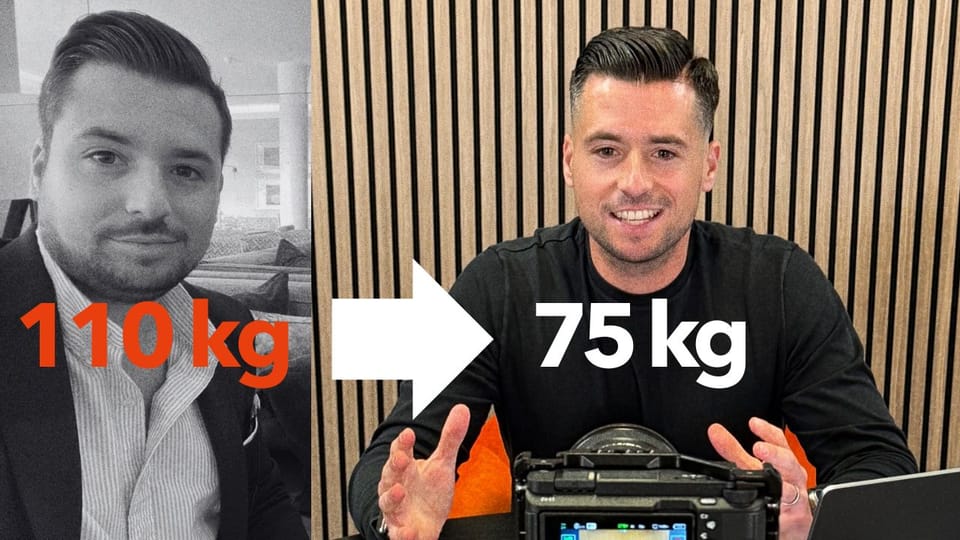
I have been fat. I have been thin. I have been somewhere in between. And the honest truth is that I have never stayed in one place for very long.
My weight has fluctuated my entire life - from childhood through my twenties, through building a business, through a wedding, through fatherhood - and it continues to fluctuate now. I am not writing this because I have solved it. I am writing this because I have not.
The first time I remember being aware of my weight, I was about seven or eight years old. I did not feel fat. I only realised it when I compared myself to the other kids. Looking back, the explanation is straightforward: I was eating more than I was burning. That is always the explanation.
I do not believe genetics make weight loss impossible. Metabolism varies between people, and a smaller body burns fewer calories than a larger one - that is basic thermodynamics. But the principle is always the same. Calories in versus calories out.
The more interesting question is not why I was fat. It is why I was eating so much.
Food is a dopamine release mechanism. Everyone knows this on some level, but not everyone experiences it the same way. For me, food has always been connected to pleasure in a way that goes beyond hunger. It is comfort, reward, and ritual.
As a child, I think I was chasing that dopamine without understanding what it was. My mother used to hide the biscuits around the house because I would find them and eat them all. She hid the mayonnaise for the same reason. At the same time, she would tell me to finish everything on my plate - food should not go to waste. That combination of abundance and obligation likely planted something deep.
This is not blame. It is observation. If my own son had the same tendencies, I would try to intervene, but I am not sure I could prevent it either.
I recognise something about myself that connects all of this: I am obsessive. When something gets into my head, I cannot shift it until I have either completed it, learned everything about it, or experienced everything I can about it. I am all in or not in at all.
This trait has served me well in business. It is the same quality that allowed me to build circle.cloud from nothing, working eighteen-hour days because I knew exactly what needed to be done.
But with food and weight management, it is more of a liability than an asset. The same intensity that drives productive obsession also drives destructive patterns. The dopamine chase that makes me relentless at work is the same one that makes me eat twelve hundred calories at half past ten at night when I know I do not need them.
I stopped drinking alcohol a few months ago, and this is not the first time. A couple of years ago, I spent just over a year without drinking. It was a year of clarity - calm, collected, sharp thinking. I did not want or fancy alcohol in any form.
Then my wife suggested I have a beer with her at lunch on holiday. Just one. It would not hurt. And she was right - one beer did not hurt. But one beer became another, and another, and slowly I returned to the same patterns that made me want to stop in the first place.
Alcohol follows a predictable cycle. You have a drink and your mood lifts from baseline to somewhere above it. When the effect wears off, you do not return to where you started - you land slightly below baseline. So the next time you drink, you are starting from a lower point, and you need slightly more to reach the same feeling. Over time, the baseline keeps dropping.
I do not know anyone who has been drinking consistently for ten years and drinks the same amount today as they did at the start. The trajectory is always upward. Alcohol is a net negative to peace of mind, and I include it here because it operates on the exact same dopamine principle as food.
At fourteen, I decided I wanted to lose weight. I started skateboarding, running, swimming. I told my mother to give me less food. I made my own plates instead of having them served to me.
I remember walking downhill toward town one afternoon, probably around four o'clock, having skipped lunch. I was so hungry I felt like my body was consuming itself. That feeling has stayed with me. Every time I lose weight now, I remember it, and I think: this hunger means my body is burning fat. This is progress.
The problem is that this state is not sustainable. You cannot restrict yourself severely and expect the result to hold. Heavy restriction leads to heavy compensation later.
I fluctuated between sixty-five and seventy-five kilograms through my late teens and twenties - small ups and downs, nothing dramatic. Then I started my business, entered a long-term relationship, and stopped paying attention.
By 2017 or 2018, the weight started creeping up. Seventy-five. Eighty. Eighty-five. Ninety. At ninety, I essentially gave up. The business needed all my attention. I told myself I would deal with my body later.
Later arrived in late 2020 at a hundred and ten kilograms.
My son was two. My wedding celebration was coming up in October 2021. I watched a documentary about an Australian man who spent three months driving across America, consuming nothing but freshly juiced vegetables and fruit. He lost a tremendous amount of weight.
The approach appealed to my obsessive nature perfectly: extreme action, extreme results, clear rules, defined timeline. I bought a juicer and started.
After a couple of weeks, I found the process messy and time-consuming, so I discovered a London company called Prescription Juices that delivered freshly pressed juice frozen to my door each week. Their formulations were designed by dietitians and doctors - each day included juices with dates, nuts, celery, kale, oranges. Proteins, fats, carbohydrates, micronutrients. Around five hundred calories per day.
I juiced for ten weeks and went from a hundred and ten kilograms to sixty-seven. I felt on top of the world.
After the wedding, I hired a dietitian. That worked for three or four months. Then the old habits crept back in. Beer after work. Nuts with the beer. Wine with dinner. By 2023, I was back at eighty-five.
I hired a personal trainer, cut out most of the poor food choices, stopped drinking. Dropped to seventy-five. I have been fluctuating around that number since - down to seventy-two, up to seventy-eight, back to seventy-four.
Right now, I am at seventy-seven. My goal is sixty-five at around twelve percent body fat. I am currently at twenty-two percent. There is work to do.
Here is where the self-awareness becomes both useful and frustrating.
Last night, I was at a boardroom event with a group of founders and CEOs. It ran from half six to half nine. I did not get back until half ten. I was not particularly hungry - I had eaten some snacks at the event - but I had not had dinner, and my brain decided that meant I deserved something.
I did not need a meal. I could have gone to bed. Instead, I walked to the shop and bought a wrap, peanuts, a yoghourt, a protein drink, and a chocolate bar. Instead of a hundred or two hundred calories, I consumed twelve hundred.
Why? Because my body wanted a small hit of dopamine before sleep. A comfort. A ritual to close the day. And I gave in.
This is the part that demoralises me. I am fully aware of what I am doing. I can describe the mechanism in detail. I know I am trading short-term pleasure for long-term progress. And I still do it.
Does this mean I do not care enough about the goal? Does it mean immediate gratification matters more to me than long-term results? I do not think so, not in the grand scheme. But something in the moment overrides what I know to be true.
I have not mastered this. I am still working on it.
One thing I have observed, and perhaps this is obvious but worth naming, is that people fall into distinct categories with weight:
I am the third type. I have a tendency toward gaining weight because I have a tendency toward overeating. But I also have the capacity for extreme restriction - juicing for ten weeks, fasting for seven days, cutting out entire food groups overnight. The result is a life spent oscillating between states rather than settling into one.
Everybody is different. That is not a revelation. But naming the pattern you belong to is the first step toward working with it instead of against it.
The juicing journey introduced me to fasting, and fasting gave me something I did not expect. It was not the weight loss - although that helped. It was the mental clarity.
When I fast, I enter a state of enlightenment that I do not experience in normal life. There is peace in not having to think about food. There is a sharpness that arrives somewhere around the twenty-four-hour mark and intensifies at forty-eight hours.
This makes evolutionary sense. When our ancestors needed to hunt, they did so while hungry. The body adapted to be sharper when fasted - alertness was a survival advantage.
The longest fast I have done was seven days. Water and black coffee only, while working alone in Dubai. Physically, I felt incredible - like God, honestly. Mentally, every single day was harder than the last. Being surrounded by people eating in a hotel cafe while you are on day four of not eating takes a toll that is difficult to describe.
I broke the fast with a steak. It was probably the nicest tasting steak I have ever had, even though it was not a great steak. I followed it with a salted caramel iced coffee, which was so good I immediately had another one.
That experience was so intense it has actually put me off long fasts since. It was mentally draining in a way I was not expecting. But I will fast again. Fasting is no longer a weight loss tool for me - it is a reset. A way to achieve a temporary state of clarity and discipline that recalibrates everything.
If your doctor approves and you are healthy enough, I would recommend trying it. Start with a day. See how it feels. The sharpness alone is worth the discomfort.
I am at seventy-seven kilograms. I want to be at sixty-five. I have cut out alcohol again. I know what I need to do. I know the mechanisms that work against me. I know my obsessive personality will drive me to extreme measures and then pull me back toward excess.
I am closer to peace with this than I have ever been. Not because the battle is over, but because I finally understand the battlefield. The dopamine. The obsessiveness. The short-term override. The restriction-compensation cycle.
I do not have the answer yet. But I have the awareness. And I think awareness, honestly pursued, is the only foundation from which an answer can eventually come.
This is my journey. It is ongoing. And I suspect it always will be.
Become a subscriber receive the latest updates in your inbox.