Five Things I Learned at the Cavell Summit Europe
Sovereignty, voice AI, and where the telecoms industry is heading
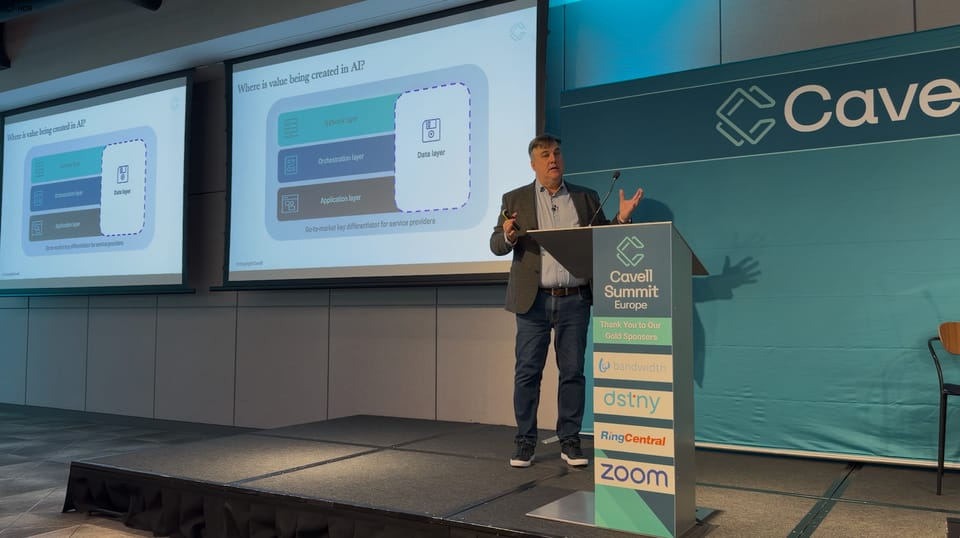
Last week I attended the Cavell Summit Europe in central London - a one-day conference that brings together the major telecoms providers, carriers, and product builders across the UK and Europe. The room was full of founders, CEOs, and market analysts. The day was packed with talks, panel discussions, and live audience polling.
I went in expecting a conversation about the state of the telecoms industry. I came out thinking about something much bigger. Five themes kept surfacing throughout the day - and they tell you a lot about where this industry is heading.
Sovereignty was one of the headline topics of the conference, and rightly so.
The concept is straightforward: data should stay within the country or region it originates from. But in practice, particularly in telecoms, it gets complicated quickly.
If you are running a voice service and your session border controllers sit in the public cloud - Amazon Web Services in the US, for example - it is entirely possible that a phone call made by your customer in London traverses the Atlantic before coming back. The call itself may be encrypted, so eavesdropping is unlikely. But the moment you introduce AI into the equation - transcription, call analysis, sentiment scoring - the data starts moving. A call recording might be sent to OpenAI for transcription. That transcription might then be processed by another service for analysis. Each hop is a potential sovereignty issue.
And the risk is not just theoretical. A US-based AI provider could receive a subpoena from the Department of Justice, and suddenly the contents of a business phone call are in the public domain. That is not a far-fetched scenario - it is a legal reality of hosting data in another jurisdiction.
The large carriers are responding by establishing physical data centres in every country they operate in. They guarantee to customers that their data does not leave that geography. When it does, the customer is told explicitly. Google announced a partnership with Mistral, a French AI company, to deliver a sovereign AI product for the European market. If a company the size of Google is partnering with a French company specifically to address European sovereignty concerns, something significant is happening. There is regulation being implemented over the coming months that will make this even more prominent.
For anyone running voice services to businesses - enterprise or SME - the question "where does my data go?" is no longer theoretical. Customers are asking it. They understand enough about the cloud to know that "the cloud" is not one place. They want specifics. And they are right to ask.
We self-host our infrastructure at We UC. Our servers sit in the UK. We run data centres in London and on the South Coast, and we even run our own AI service on our own infrastructure. All the call recording transcription, analysis, and summarisation happens locally. You do not need the most powerful models in the world to do transcription and summarisation - that is a common misnomer. We have managed to do this on our own infrastructure, keeping all data within the UK. It is one of the decisions we made early on, and watching this conversation unfold at the conference reinforced that it was the right one.
There was a lot of talk at the conference about how AI is going to disrupt the workplace. How AI will impact telecoms. How businesses should plan for AI.
It struck me that the conversation is framed incorrectly.
AI is not a feature you bolt on. It is not a module you activate. It is closer to electricity - so fundamental, so omnipresent, that discussing "how electricity will impact our business" would sound absurd. Yet that is essentially how parts of the telecoms industry are still treating AI. As something new. Something to plan for. Something to discuss at conferences.
The reality is that AI has already changed how most knowledge workers operate. It has already rewritten the economics of software development, customer service, content production, and data analysis. Treating it as an upcoming disruption misses the point. It is the new baseline.
I think this reflects a divide that has been growing for years - between traditional telecoms companies and modern software companies.
Traditional telecoms providers are, by nature, infrastructure businesses. They operate on BSS and OSS systems that were built decades ago. Their software development practices prioritise stability and basic functionality over innovation. The interfaces are over-complicated. The architecture is legacy. The appetite for rapid change is low - not because the people are not smart, but because the systems and culture were built for a different era.
On the other side, you have companies like ElevenLabs. Born in the modern era. Running on Kubernetes. Advanced CI/CD workflows. AI woven into every part of how they build and ship. They care about design, about user experience, about craft. They do not have twenty years of technical debt weighing them down. They move at a completely different speed.
The telecoms industry is full of companies operating like it is still 2010. Meanwhile, modern software companies are building products that interact with the same customers, solve the same problems, and move ten times faster. That creates a gap - and it is widening.
The conference organisers positioned sovereignty as the main theme. And it was well covered. But the topic the audience actually wanted to discuss - overwhelmingly, based on a live poll at the start of the day - was voice AI.
It is not hard to see why.
One of the demonstrations came from Bandwidth, an international carrier with a strong presence in Europe. They partnered with a hotel chain and implemented a voice AI solution that handles the front desk. Guest calls about room service orders, booking modifications, general enquiries - all handled by AI with access to the hotel's booking system. The problem it solved was simple: during busy periods, the hotel did not have enough staff to answer every call. Guests were left waiting. With voice AI, the constraint disappears. You can have thousands of agents handling calls simultaneously, freeing human staff to focus on face-to-face interactions.
Another example: a restaurant chain facing the same problem. At peak hours, waiters cannot answer the phone. Customers calling to book a table, modify a reservation, or ask about the menu are left on hold or unanswered. A voice AI solution with access to the restaurant's systems solves this immediately.
These are not theoretical use cases. They are live deployments.
The interesting tension in this space is between two camps. On one side, tech startups are building voice AI solutions rapidly but often know nothing about telecoms. They do not understand session border controllers, call switches, or quality of service at the network level. They route calls through an API to something like Twilio so they can make and receive phone calls, and they ship the product. They know the customer. They win the deal. But the quality of service cannot be as good as if they owned the whole stack. If these startups understood how a soft switch works, how to route calls on-premise, how to run phone calls at scale on their own network - the call quality would be better, the troubleshooting faster, and the whole thing cheaper and more stable long-term.
On the other side, traditional telecoms providers understand the infrastructure deeply but are too slow to build these solutions themselves. They provide the telecom services but not the value-added solutions on top. Meanwhile, the startups are putting voice AI products in front of the telco solution and extracting margin from providers who should be delivering it themselves.
There is a gap between the two. And I believe We UC sits in that gap. We have the software skills and the pace of a modern company. We also have the telecoms experience - the soft switch experience, the network we are running ourselves. We are positioned at the intersection of a modern software company and a traditional telco. That middle ground is where the opportunity is. It is also where we are building Ringup, our voice AI product that will be built directly into We UC.
A recurring message at the conference: the traditional telephony pricing model is dying.
The argument is straightforward. Services like WhatsApp have normalised free communication. A WhatsApp call costs nothing because it does not touch the public telephone network - both endpoints are controlled by the same company within a closed environment. But that creates a perception that all voice communication should be free. The ten or fifteen pounds per user per month model, with bundled minutes and a standard feature set, is gradually losing its value.
Businesses still have phone numbers. That is still the universal method for communicating with businesses through voice. But the pricing pressure is real.
So how do telecoms companies remain profitable?
The answer that emerged clearly from the conference: value-added services.
What does that mean in practice? Three things stood out.
First, data analytics and reporting. Connecting a customer's CRM, financial system, and phone platform so that data appears in one place - dashboards and scheduled reports that cover not just call activity but business performance.
Second, voice AI. Tools like Ringup, which we are building into We UC, that give businesses the ability to implement AI agents within their phone system. Not just agents that answer calls and take voicemails, but agents that can perform actions - booking appointments, modifying reservations, updating records - because they plug into the CRM integrations already in place.
Third, integrations themselves. Most businesses run a CRM or a financial system or some kind of platform to manage their operations. Integrating into these platforms allows a productivity boost, an efficiency boost, and allows customers to do their best work by having access to the best technology for their business.
The core voice licence becomes the entry point. The real margin lives in the solutions built on top of it.
For anyone building in the telecoms space, the message was clear: the commodity is the phone line. The value is everything you build around it.
The final theme that stayed with me is about focus.
We are preparing to sell We UC as a software-as-a-service product. In a crowded market - and unified communications is a very crowded market - having a product that solves many problems for many people is not a differentiation strategy. It is a path to invisibility.
I remember a marketing brochure from about ten years ago, when "cloud" was the buzzword. The headline was: "How do you stand out from the cloud?" It was a clever line then. It is even more relevant now, because the market is noisier than it has ever been.
The approach we are evaluating is straightforward: specialise.
In order to stand out, you need to understand the customer and understand their workflow. You need to know how they operate day to day and know what problems they have so well that you can create a solution that removes friction - so they can solve those problems faster and better with your product. The only way to do that at scale is to specialise.
Either you verticalise - specialise in a particular industry and solve a problem that industry has, because you understand it deeply enough to solve it well. Or you specialise in a particular solution that applies across multiple industries, but you solve the problem within that solution extremely well.
We are evaluating both paths right now. But the principle is clear: in a noisy market, the businesses that succeed are the ones that are laser-focused on solving one problem better than anyone else. Not something generic. Not "we do everything for everyone." Something specific for one specific type of customer - and being the best in the world at it.
That is what we are going to focus on with We UC. Once we have made the decision on which segment, every piece of marketing and every product decision will be shaped by it.
The Cavell Summit condensed a lot of the themes I have been thinking about into a single day. Sovereignty is real and getting more urgent. AI is not a feature - it is the foundation. Voice AI is the most immediate disruption in telecoms. Traditional pricing models are eroding. And the only way to build something visible in a crowded market is to be specific about what you do and who you do it for.
None of these ideas exist in isolation. They overlap. The company that builds a communication platform with AI at its core, that handles data in a sovereign way, that is able to solve really specific problems better than anyone else, and that specialises in a particular vertical or solution - those are the companies that will win.
That is what we are building with We UC. And conferences like this one remind me that we are heading in the right direction.
If you want my operating framework for running at full capacity as a founder and CEO, it is free at axelmolist.com/ceo-os.
Become a subscriber receive the latest updates in your inbox.