I Spent Five Years Building Something Nobody Asked For
The story of building We UC from scratch.
Everyone tells me the same thing. Just resell someone else's platform. It would be cheaper. It would be faster. It would make more business sense.
They are not wrong about any of that.
But they are wrong about what matters.
My journey in telecoms started in 2012. I was working for a company that sold Siemens phone systems - physical boxes the size of three shoeboxes, plugged into walls underneath desks or shoved into corridors. On-premise PBXs for small businesses with five to ten users.
I could see that cloud was the future. It was obvious to me. I went to the owners and told them we needed to be selling cloud telephony. They disagreed - there was not enough money in it.
So I set up a company on the side. I got sacked for it. And that company became circle.cloud.
That decision - following my gut when the economics said otherwise - set a pattern I have repeated ever since.
When I started circle.cloud, I needed a platform to resell. The obvious choice was Horizon by Gamma - solid, well-known, built on Broadsoft under the hood. But it was what everybody else was selling. I wanted something different.
I found a company called The Voice Factory, run by a man named Paul Harrison. Paul used to work at Broadsoft, and after he left he set up The Voice Factory and invested in his own Broadsoft platform. He believed in me at a time when I was just a person with a brand new company. Getting a reseller agreement with a telecoms carrier in 2015 was not as easy as it is today. You needed trading history, investment, industry connections. I had none of that. Paul took a chance on me anyway, and I have a tremendous amount of appreciation for that.
What drew me to Broadsoft was its architecture. The platform separated every service into its own cluster - one for the application layer, one for the database, one for media, and so on - all isolated, all horizontally scalable across multiple zones, meaning multiple data centres. You simply stack more servers in each zone when you need more capacity. It was the industry standard for good reason. Companies like Telefonica, Vodafone, and BT run their telephony on Broadsoft. You needed around four million pounds in capital to get a carrier-grade Broadsoft installation and licences, which was well beyond our reach at the time.
The initial years went well. We grew. But our billing costs grew too. We were spending around twenty thousand pounds a month on licence fees.
That made me start looking for alternatives.
I found a company called Bicom Systems that built their own cloud PBX on Asterisk. The licence fees were dramatically lower - charged per server rather than per user, with each server handling around 1,500 users. We made the switch.
At first, our software ran on Bicom's servers in their data centre. Then they had an outage in Milton Keynes. Two to three hours of no service for our customers. It made my blood boil. Their infrastructure standards were not where ours needed to be.
So we found our own data centre - a company called Netwise Hosting in central London, run by two founders who had built something remarkable. Small team, but the quality was extraordinary: diverse network paths, multiple carriers, Cisco routers in the core, multiple generators, multiple fuel contracts. We bought a quarter rack, installed our own servers, and ran the Bicom software on our hardware.
Then Netwise got hit with a DDoS attack. Not targeting us - targeting another customer. But because we shared the network, our service went down for three to four hours.
That was the moment I decided we would never again run our infrastructure on someone else's network. We invested in our own routers, our own switches, and established direct relationships with carriers for connectivity into our data centre.
Looking back, the evolution was a staircase:
Step four is where the real story begins.
I knew what I wanted: a platform with the scalability of Broadsoft but without the four-million-pound licence fee. Broadsoft had been acquired by Cisco by this point. I actually inquired heavily about obtaining a Broadworks platform, but the economics did not work.
The breakthrough came almost by accident. I was on a call with a telecoms consultancy from Argentina. Our requirements did not quite match what they could offer, but at the end of the conversation, one of them mentioned a small company in San Francisco called 2600 Hz that had built something called Kazoo. I had never heard of it. I made a note and moved on.
Months later, I hired a systems administrator named Konstantins - highly skilled, had built software products before. When I told him my goals, he said we could build something with one developer and have it in the market within six months. That turned out to be optimistic, to say the least.
What made Kazoo compelling was that it was architected as an open-source alternative to Broadsoft. Multiple application servers, multiple media servers, multiple SBCs, a distributed message bus - all capable of running across geographical zones. You could have a cluster in London and another in Amsterdam, failing over between them seamlessly. It was built for carriers and for scale. And it was open source, which meant no licence fees and full control.
We installed Kazoo, set it up in a distributed architecture, and started building.
The original plan was modest. Kazoo came with an open-source frontend called Monster UI, and we started by building a call recording application on top of it. That was meant to be the missing piece.
Within two months, Konstantins saw something bigger. Instead of bolting applications onto Monster UI, we should build our own platform from scratch - our own API, our own interface, our own product. One that talked to Kazoo for the PBX features but was entirely ours in terms of the user experience.
That decision changed everything.
We called it Circle UC at first. Then one day, the name We UC came to me. I was in the circle.cloud office and overheard Adam, one of the sales team, say, "I am just going to transfer this call to my director." Not our director. My director. We had grown fast - from ten employees to fifty or sixty in a few months - and somewhere in that growth, people had stopped thinking of the company as a team. It became "us and them."
The name "We" came from that realisation. It is inclusive. It promotes collaboration, not just communication. It makes people think of a company as a single force rather than separate departments. That is exactly what a unified communications platform should do. We paired it with UC - unified communications - and We UC was born.
What started as building a custom proposition for circle.cloud turned into something much bigger. We hired more developers. We set up sprints, CI/CD pipelines, infrastructure, DevOps processes. We registered We UC Ltd. We built native iOS and Android apps, a desktop app, a web app. We now have a team of over twenty people.
We became a software company almost by accident. And I love it.
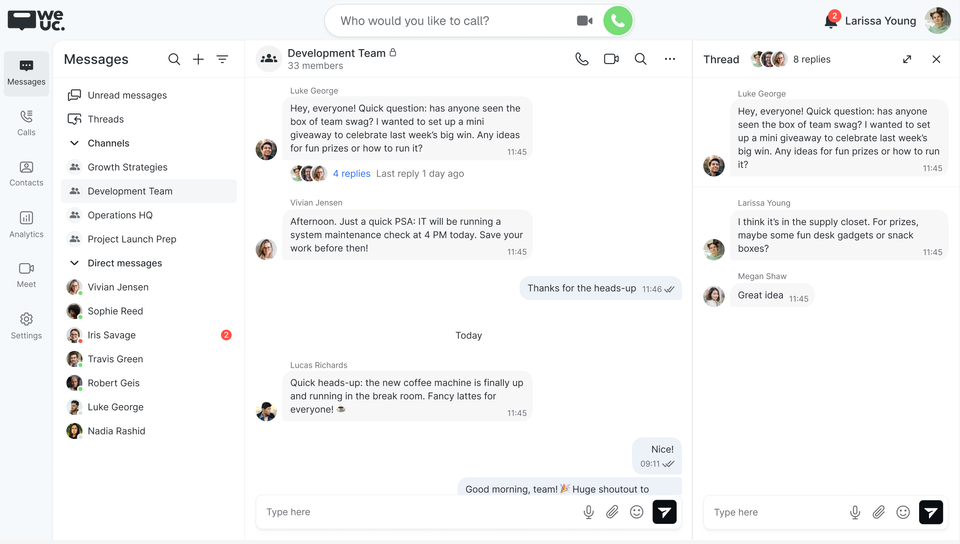
We UC is a modern business phone system. A unified communications platform that handles calls to telephone numbers via audio, internal calls via audio or video, messaging, meetings, call reports, and analytics - all in one application.
The basics are now solid. We are on par with our previous platform in terms of features and stability, and we are onboarding customers. One recruitment business is already running on We UC, with more to follow.
But the basics are just the foundation. What excites me is what comes next.
We are building customisable dashboards that do not just display telephony data but pull in information from CRMs, support systems, and accounting platforms - a small business BI tool that gives founders a 360-degree view of their operation in a single screen. We are building voice AI agents that sound human, connect to business systems via MCP servers, and can handle tasks like restaurant bookings or appointment scheduling. We are building omnichannel messaging that brings WhatsApp, email, Facebook Messenger, and Google My Business conversations into a single interface alongside internal chat.
These are not features for the sake of features. They are tools that will genuinely impact small businesses' efficiency and profitability.
Enterprise companies have had this technology for years - data warehouses, Power BI, AI assistants, omnichannel support. Small businesses are still logging into six different platforms every morning and lack a centralised view of their data and operations. I want to change that.
That is the real answer to why I built this. Not because someone asked. Because someone should have. As Steve Jobs put it: "People don't know what they want until you show them."
Five years of building something nobody asked for has taught me a few things.
Follow your gut, even when the economics say otherwise. Every major decision I have made - leaving my first job to start circle.cloud, moving off Broadsoft, investing in our own infrastructure, choosing to build from scratch on Kazoo - looked questionable on a spreadsheet. Every single one turned out to be right.
Control your stack. When something goes wrong and your service runs on someone else's network, on someone else's software, on someone else's servers, you cannot fix it. You can only wait. That is an unacceptable position. The buck has to stop with us.
Building it yourself takes longer but lasts longer. We could have hired consultancies to build everything and moved faster. Instead, we learned Kazoo ourselves, hired expertise in-house, built the knowledge internally. It took more time. But now we own every layer of understanding, not just every layer of technology.
Craft is not a luxury. We care about details nobody will ever see. The architecture of the codebase, the elegance of the API, the precision of the UX. That care comes through in the final product, even when the customer cannot point to exactly why it feels different.
You do not need permission to build what you believe in. Nobody asked for We UC. The market did not demand it. A consultant would have told me to keep reselling. But the best products are built by people who see something that does not exist yet and refuse to accept that gap.
Kazoo itself is open-source software, and we are actively contributing back to it - working alongside carriers from all over the world, maintaining a shared codebase. That is the beauty of open source. You build on something great and make it greater. But for us, Kazoo is just the PBX engine. On top of it sits everything from messaging to video calling, online meetings, call recording transcription and summarisation, and much more - all wrapped around a user experience that is entirely ours.
I have no plans to sell We UC. I want to build it and keep building it. That is what I enjoy doing.
We are launching in the UK first, then the US, Europe, and potentially Australia. We are selling through circle.cloud's existing sales engine and, soon, via a self-service SaaS model - which is entirely new territory for me and genuinely exciting.
I want We UC to become a recognised name in unified communications. Not because it is the biggest, but because it is built with more care, more craft, and more attention to detail than anything else in the market.
That is what five years of building something nobody asked for has given me. Not just a product, but a conviction: the things worth building are rarely the things that make obvious sense at the start. They are the things you cannot stop thinking about. The things that keep you working not because you have to, but because you genuinely want to.
And I have never wanted anything more.
Become a subscriber receive the latest updates in your inbox.